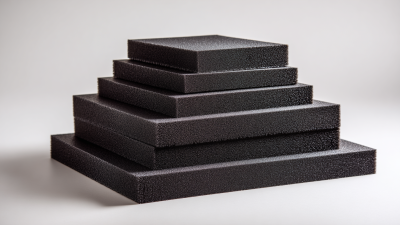





2026 Top Biodegradable Foam Suppliers for Global Buyers
Global buyers are entering 2026 with sharper questions about packaging performance, environmental claims, and supplier reliability. Biodegradable Foam now appears in protective packaging, food-service products, insulation, and agricultural applications. Yet the label alone proves very little. Buyers must examine feedstocks, expansion methods, moisture resistance, cushioning strength, and end-of-life conditions.
Dr. Ramani Narayan, a respected bioplastics scientist at Michigan State University, explains, “Biodegradability depends on the material and the environment where disposal occurs.” That distinction matters. A foam may degrade in an industrial composting facility but remain stable in a household compost bin. Small details change the result.
This guide evaluates the 2026 Top Biodegradable Foam Suppliers for Global Buyers through a practical procurement lens. It considers product consistency, technical documentation, production capacity, customization, testing transparency, and communication quality. Samples matter. So do carton dimensions, storage temperatures, lead times, and shipping records.
No supplier is perfect.
Some companies offer strong materials but limited regional support. Others provide attractive prices but incomplete testing data. This guide highlights those trade-offs instead of repeating polished marketing language. It also separates genuinely biodegradable foam from products that merely contain plant-based ingredients. Buyers should request independent test reports and clear disposal guidance before signing contracts.
The market is developing quickly, and some claims remain difficult to compare. That uncertainty deserves attention. Reliable sourcing requires evidence, careful questions, and realistic performance expectations.
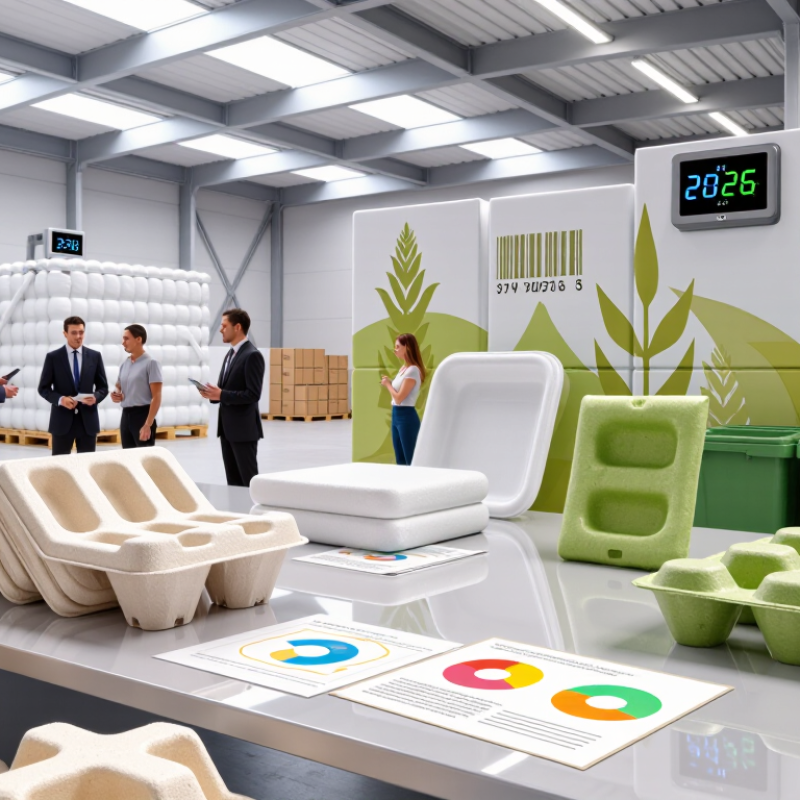
Biodegradable Foam Types: PLA, PHA, Starch, and Mycelium Performance Data
Biodegradable foam is not one material with one performance profile.
PLA, PHA, starch, and mycelium respond differently to heat, moisture, and impact.
PLA foam typically offers densities near 35–90 kg/m³ and thermal conductivity around 0.035–0.050 W/m·K. It provides clean cushioning for electronics and food-service packaging, but industrial composting may be required. Real-world results vary.
PHA foam can biodegrade in more environments, including some soil and marine conditions, depending on formulation. Its density often falls between 40 and 120 kg/m³. PHA shows useful moisture resistance, yet production scale and cost remain difficult concerns.
Starch foam is lightweight, commonly 20–70 kg/m³, and can absorb impact effectively. It is also sensitive to humidity. A damp warehouse can change its shape.
Mycelium foam uses fungal growth around agricultural fibers, creating molded protective inserts. Typical densities range from 80–180 kg/m³, with good compression recovery for bottles, furniture parts, and fragile components.
Surface uniformity can be less consistent than molded polymer foam. That is not always a defect.
Buyers should request compression, drop, moisture, and aging data under actual shipping conditions. Test reports should identify temperature, humidity, specimen thickness, and composting method. Some supplier figures remain too optimistic, so independent verification is worth the extra time.
Global Supplier Mapping: Production Capacity, Export Reach, and MOQ Benchmarks
Global buyers should map biodegradable foam suppliers by verified output, not catalogue breadth. European Bioplastics reported global bioplastics production capacity at about 2.47 million tonnes in 2024, rising toward 5.7 million tonnes by 2029. This covers all bioplastics, not foam. Foam availability is smaller and uneven.
Supplier capacity usually falls into three practical tiers. Pilot producers may offer 100–500 tonnes annually, while regional converters can support 1,000–5,000 tonnes.
Large export-oriented plants may exceed 10,000 tonnes, but capacity claims need production records and shipment evidence. Ask for monthly output, resin origin, line utilization, and export ports. These details matter.
UN Comtrade data for cellular plastics under HS 3921 can indicate export reach, although the code does not separate biodegradable materials. That limitation deserves attention. Export-active suppliers often quote 500–2,000 kilograms for trials and 5–20 tonnes for repeat orders. Custom molds may raise minimums. Some suppliers still publish vague MOQs. That is a warning.
The Smithers report, The Future of Sustainable Packaging to 2028, links packaging growth with material traceability and recycling performance. Buyers should therefore compare certificates, test methods, lead times, and destination documentation. A low MOQ may hide higher unit costs, unstable foam density, or weak container utilization. In practice, the cheapest quotation is not always the most reliable shipment.
Certification Screening: ASTM D6400, EN 13432, and ISO 17088 Requirements
Global buyers should screen biodegradable foam suppliers through certification evidence, not marketing language. ASTM D6400 evaluates compostable plastics under controlled industrial composting conditions. EN 13432 adds requirements for biodegradation, disintegration, material safety, and compost quality. ISO 17088 provides another internationally recognized framework for compostable plastics. These standards do not prove decomposition in soil, oceans, or a household compost bin.
The market is expanding quickly. European Bioplastics and nova-Institute reported global bioplastics production capacity of about 2.47 million tonnes in 2024, with projections reaching approximately 5.73 million tonnes by 2029. This growth increases the need for careful supplier verification. Request the complete certificate, testing laboratory details, product formulation, and certificate scope. Check whether the approval covers the foam itself, coatings, adhesives, inks, and additives. A certificate for one resin may not cover the finished packaging.
Ask suppliers for recent disintegration and ecotoxicity test reports. Confirm the testing conditions, sample thickness, and industrial composting temperature. Foam geometry matters. Thick sections may break down more slowly than thin films. That detail is often overlooked. Certification can also expire or exclude later formulation changes. Buyers should therefore compare documents with production samples and arrange independent testing when shipment volumes are significant. The 2024 Global Plastics Outlook from the OECD also highlights the continuing growth of plastic waste, making credible end-of-life claims increasingly important. One weakness remains: certification cannot guarantee that suitable composting infrastructure exists in the buyer’s destination market.
Compostability Testing: 12-Week Disintegration and 6-Month Biodegradation
For buyers comparing biodegradable foam suppliers in 2026, compostability evidence deserves close attention. A 12-week disintegration test shows whether foam physically breaks apart under controlled composting conditions. It does not prove complete biological conversion. Pieces may disappear visually while leaving smaller residues behind.
A six-month biodegradation test examines microbial activity and carbon conversion over time. Reliable laboratories record temperature, moisture, oxygen, sample mass, and reference materials. They should also report test conditions clearly, because industrial composting differs from home composting. Ask for full test reports, not only certificates or percentage claims. From practical evaluations, inconsistent sample thickness can change results. That detail is easy to overlook. A clean laboratory result may still need real-world review.
Tips: Request samples from different production batches. Check whether adhesives, coatings, or printed layers were tested with the foam. Compare the 12-week disintegration data with the six-month biodegradation data. Keep supplier records, laboratory methods, and batch numbers together. If the report uses vague terms, ask specific questions. Good evidence should be readable, repeatable, and connected to the product you will actually purchase.
Supplier Comparison: Pricing, Lead Times, LCA Results, and Customization Data
Global buyers need more than a biodegradable label. They need comparable evidence.
A 2024 European bioplastics industry report projects global bioplastics capacity to rise from about 2.47 million tonnes in 2024 to 5.73 million tonnes by 2029. Supply is growing, but feedstock and certification still affect pricing.
Pricing
USD 2.50–6.00 per kilogram
A practical RFQ benchmark places molded biofoam near USD 2.50–6.00 per kilogram. Pricing changes with density, volume, tooling, and barrier coatings.
Lead times
3–8 weeks
Lead times commonly range from three to eight weeks for standard grades. Custom molds may require eight to fourteen weeks.
Ask suppliers to separate tooling time from production time. LCA results need equal boundaries. The European Commission’s Product Environmental Footprint method requires defined system limits, energy data, and end-of-life assumptions.
A supplier claiming “60% lower emissions” may exclude transport or industrial composting. That is not necessarily dishonest, but it is incomplete.
Request cradle-to-gate carbon data, water use, recycled content, and disposal conditions.
Customization can include wall thickness, compression strength, color, moisture resistance, and printed surfaces. Every added feature can affect recyclability or compostability.
Tips:
Request three samples from different production lots. Test them at 23°C and high humidity. Record compression loss after 24 hours.
Confirm the minimum order quantity, mold ownership, replacement policy, and certification scope in writing.
A 2024 materials outlook from an international energy agency also warns that bio-based feedstocks do not automatically guarantee lower lifecycle impacts. Claims need measurable evidence.
Related Posts
-
How to Choose the Right Foam Packaging for Your Products
-
Best Shipping Styrofoam Solutions for Global Buyers?
-
Explore China's Top Molded Pulp Innovations: Quality Products for Global Buyers
-
How to Choose the Best Shipping Cooler Box for Your Business Needs
-
Transforming Logistic Efficiency: The Role of Insulated Shipping Boxes in the 2025 China Import and Export Fair
-
How to Choose Biodegradable Foam: Key Factors Impacting Environmental Sustainability